Squash vs pickleball vs padel: the differences that matter
Squash vs pickleball comes down to this: squash is singles in a four-walled court, with a fast, low-bouncing ball and a point on every rally to 11. Pickleball is doubles on an open court, with a slow plastic ball and an underhand serve you can learn in a minute. Padel sits between them.
Squash vs pickleball vs padel: the quick comparison
| Squash | Pickleball | Padel | |
|---|---|---|---|
| Court | 32 × 21 ft (9.75 × 6.4 m), enclosed | 44 × 20 ft (13.4 × 6.1 m), open | 65.6 × 32.8 ft (20 × 10 m), enclosed |
| Walls in play | All four | None | Yes, once the ball has bounced on the floor |
| Default format | Singles | Doubles | Doubles |
| Scoring | Rally points to 11, best of five | Side-out to 11, win by 2 | Tennis games and sets, best of three |
| Serve | Any motion, into the front wall between the service line and the out line | Underhand with contact below the waist, or a drop serve | Underhand, after a bounce, at or below the waist |
| Net or tin | 19 in (48 cm) tin; 17 in on the men's pro tour | Net 34 in at center, 36 in at the posts | Net 88 cm (35 in) at center, 92 cm at the posts |
Scoring: rally points to 11 vs side-out to 11
Squash uses point-a-rally scoring to 11. Every rally scores, whoever served, and at 10-10 you play on until someone leads by two. Matches are best of five games. Older English scoring — games to 9, only the server scores, receiver's choice of 9 or 10 at 8-8 — still turns up in club leagues, so ask before you start. The variants are laid out in squash scoring.
Pickleball's default is side-out scoring: only the serving side can score, games go to 11, win by two. In doubles both partners serve before the ball passes to the other team, except at the start of a game, when the first serving team gets one server. Rally scoring exists as an option a tournament director can select, and it shows up in pro team formats, but side-out is what the rulebook defaults to. The effect: a side-out game can run 30 rallies and still sit at 6-4.
Padel borrows tennis wholesale — 15, 30, 40, games, sets, best of three. Deuce is where it splits. Club play commonly uses the golden point: one decisive point at 40-40, with the receiving pair choosing which side takes it. Since January 2026 Premier Padel and the FIP tours play the star point instead — up to two advantage cycles, then a deciding point at the third deuce. Plain advantage scoring is still around below that.
Learning curve: which one you can play on day one
Pickleball is the easiest to start, and it isn't close. Big paddle face, slow ball, a 20 ft wide court, and a two-bounce rule — the serve must bounce, the return must bounce — that forces a rally into existence before anyone can end it. Most people sustain a rally in their first ten minutes.
Padel is nearly as friendly: underhand serve, a partner covering half the court, and back glass that gives you a second swing at balls that would be winners in tennis. The ceiling is high — reading rebounds, the bandeja and víbora — but nothing stops a beginner from playing immediately.
Squash is the hard one, for a reason beginners rarely anticipate. A double-yellow-dot ball is built to stay dead until it's warm, and it won't warm up unless two people hit it hard for several minutes. Start with a blue or red dot instead and the first session works — see squash ball for beginners. The second hurdle is coverage: you're alone, and the ball comes back off angles you have to learn to read.
Is squash a good workout compared with pickleball and padel
Squash produces the highest work rate of the three, for structural reasons rather than effort. You cover the whole court alone, the ball dies if you don't reach it, and the four walls keep alive shots that would be winners on an open court. The movement — lunge, decelerate, twist, push back to the T — loads the legs on nearly every rally.
Pickleball's work rate is lower by design: half a court, a partner, a slow ball, and a non-volley zone that turns stretches of the game into soft dinking. That's a feature. It stays playable for three hours and well past the age when squash singles gets unrealistic.
Padel lands between them. The glass extends rallies past what tennis produces, but two players still split a 10 m width and the pace is moderate.
Treat calorie tables skeptically. Burn depends on bodyweight, rally length, and how hard you're chasing — the same hour of squash is a jog or a beating depending on the opponent. Heart rate is the honest comparator, and hour for hour a competitive squash match holds most players in a much higher band than rec pickleball.
Singles, doubles, and what that changes
Squash is a singles sport almost everywhere; its Olympic debut at the 2028 Games in Los Angeles is singles only, with 16-player men's and women's draws. Doubles squash exists on a wider purpose-built court, but only at a handful of clubs. The other two run the opposite way: pickleball doubles is the default, and padel is doubles apart from a few narrow singles courts.
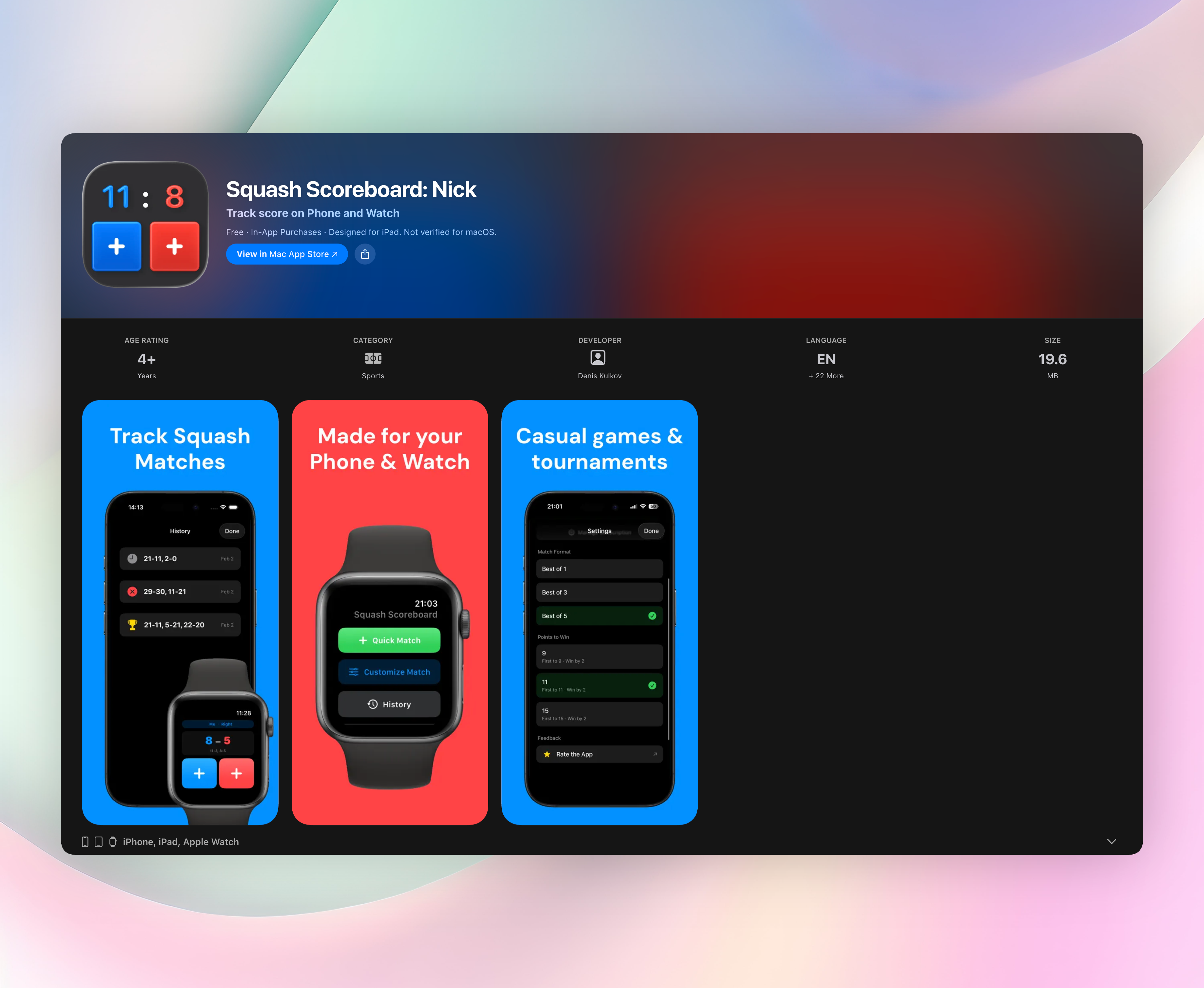
That decides more than it sounds like. Pickleball and padel need four people and a booking; squash needs one opponent, which makes a 7 a.m. weekday match far easier to arrange. It also changes what you track — a squash match is one-on-one, best of five, with a point scored on every rally, which is the format Squash Scoreboard, a squash scoreboard app for iPhone and Apple Watch that tracks match scores, is built around.
Court availability in the US
Pickleball wins this outright. Courts sit in public parks, on tennis courts with pickleball lines painted over them, and in school gyms and community centers across nearly every metro.
Padel is growing fast from a small base and stays concentrated — Miami, New York, Los Angeles, Austin, Dallas, and Houston hold most of it, nearly all at private clubs, since a padel court is a purpose-built glass-and-mesh structure, not paint on asphalt.
Squash sits in the middle with a specific footprint: universities, urban athletic clubs, some YMCAs, and dedicated squash centers, densest in the Northeast. The upside is standardization — a WSF-spec singles court plays the same in Boston as in Cairo, because squash court dimensions are fixed.
Squash vs table tennis
The shared 11-point format makes these look related. Table tennis plays to 11, win by two, best of five or seven, with serve alternating every two points — every point once the score reaches 10-10. Squash also scores to 11, but serve follows the rally winner, so there's no rotation to track.
Physically they're opposites. Table tennis is reaction speed and footwork measured in inches, with little joint load. Squash is whole-body endurance and heavy lunging. The skills barely transfer.
FAQ
Is squash harder than pickleball?
Considerably. Pickleball is playable in your first ten minutes; squash usually takes a few sessions before rallies hold together, mostly because of ball temperature and swing length. Physically squash asks far more, since you cover the full court alone with little dead time.
How many calories does squash burn?
Squash calories burned in an hour come down to bodyweight and how long the rallies run, so any single figure is an average across a wide range. What holds up is the ranking: squash sits at the top of racket sports for intensity, above padel, pickleball, and table tennis at comparable effort.
Squash vs padel — which is the better workout?
Squash, at equal effort. A padel player shares the court with a partner and hits at a moderate pace, with the glass turning would-be winners into longer rallies rather than more sprints; a squash singles player covers a small court alone and changes direction constantly. Padel is kinder to the joints and easier to keep playing for decades.
Can a pickleball or padel player pick up squash quickly?
The movement transfers better than the swing. Both reward a short, punchy stroke, while squash needs a longer swing with an open face to lift the ball off a low bounce. Padel players do get a head start on reading rebounds off the back wall.
Free Squash tools
- Squash Court Measurement CalculatorEnter a squash court plan's dimensions to create a clear checklist in metres, feet or inches for singles or doubles.
- Squash Racquet SelectorAnswer four fitting questions to get a squash racquet specification to shop with, plus reasoning and an alternative to try.
- Squash String Tension GuideChoose your playing standard, priority and string type, then compare your current tension with a practical squash recommendation in lb and kg.