Squash boast, drop, nick and every other shot worth playing
The squash boast is any shot that hits a side wall — or the back wall — before it reaches the front wall. Its job is to change the ball's direction, usually to drag an opponent out of the back corner and into the front. It's one of eight shots worth owning.
Squash shots at a glance
| Shot | What it's for | Where it has to land | When it's wrong |
|---|---|---|---|
| Straight drive (rail) | Pinning them behind you | Tight to the wall, dying in the back corner | Almost never |
| Cross court | Moving them across | Far side wall, behind the service box | They're on the T, volleying well |
| Boast | Dragging them to the front | Two bounces near the opposite front corner | You're behind them, off the T |
| Drop | Ending the rally short | Inches above the tin, dying before the short line | You're deep, they're on the T |
| Lob | Buying time, resetting | Over their reach, into a back corner | A tall, willing volleyer |
| Volley | Taking time away | Anywhere; the point is intercepting | Ball above your shoulder, stretched |
| Kill | Punishing a loose ball | Low front wall, two bounces before the box | The ball is below your knee |
| Nick | Ending it outright | The side wall/floor junction | You can't afford the miss |
The straight drive, or rail
Every other shot borrows from this one. Played from the back of the court down the side wall, it forces your opponent behind you and leaves you on the T.
The target is the back corner, not the front wall: aim about a meter above the tin, hard enough that the second bounce lands in the back quarter. A drive clinging to the wall beats one hit twice as hard down the middle. If your drives keep rebounding off the back wall and sitting up, add height before taking pace off.
The cross court: width, not pace
The cross court is the drive's escape route. You play it under pressure on one side to restart the rally on the other, and it lives or dies on width.
Aim so the ball strikes the far side wall level with, or just behind, the service box, past the point where your opponent can step across and cut it off. One that hits the wall in front of them rebounds into the middle as a free attack. Against someone settled on the T, a tight straight length is the safer exit.
The squash boast: two-wall, three-wall and trickle
The ball may hit any number of walls first, as long as it reaches the front wall above the tin and below the out line without touching the floor on the way. The direction change costs you position: you hit from a corner while your opponent sits nearer the middle.
Two-wall boast
The standard angle. From the back corner, hit low into the near side wall; the ball crosses to the front wall and dies in the opposite front corner, bouncing twice before the front of the far service box.
It's a mistake when your opponent is level with or ahead of you. Boasting from behind someone on the T invites a straight drop into the corner you just left. Repeating it from the same corner is the other mistake — decent players start leaving early.
Three-wall boast
Hit harder and higher into the near side wall so the ball runs side wall, front wall, far side wall, kicking out near the far service box. It attacks an opponent stuck deep, since the ball crosses the front away from them. Against anyone quick to the front it's a liability: one coming off the far wall high sits up in the middle.
Trickle boast
Played from the front, softly into the near side wall so the ball creeps into the front corner. The shot is disguise: set up exactly as you would for a straight drop, then open the face.
The danger is your body, not the shot. Play it when you're not clearly in front and you'll end up between your opponent and the ball, turning a winner into a let or a stroke against you. The skid boast is the high variant: hit into the side wall near the front so the ball loops into the opposite back corner.
The drop shot: the tin decides everything
A squash drop shot is a soft ball hit low on the front wall so it dies in a front corner. Your margin is the tin: 0.48 m (19 inches) under the World Squash Federation court specification, though PSA-sanctioned professional events use a lower 0.43 m (17 inch) tin. Clip it and the rally is over, and the court dimensions are standardized, so the target never moves.
Aim a few inches above the tin, second bounce before the short line. The straight drop is the percentage version: even a loose one stays near the wall, while a cross-court drop that runs long is a free ball in the middle. Dropping from deep while your opponent is on the T just hands them a short ball you're two strides further from.
The lob: the shot club players skip
The lob is a high, soft cross court that passes over your opponent's reach and drops into a back corner — the cheapest way to buy two seconds and reclaim the T after being stretched to the front.
Height is limited. The out line drops from 4.57 m on the front wall to 2.13 m on the back wall, so a ball still climbing when it gets there is out. A good lob arrives with almost no pace and dies in the corner instead of rebounding off the back wall. Skip it against a tall opponent who volleys above their head, or on a hot court where the ball keeps carrying.
The squash volley: stealing time
Volleying isn't a shot, it's a decision applied to the others — volley drive, volley drop, volley boast, volley nick. Taking the ball out of the air cuts your opponent's recovery time and keeps you on the T instead of walking backwards. Meet it in front of your body with a compact swing, and skip it when the ball is above shoulder height and you're stretched: a firm straight length beats a volley cross court that comes back loose.
Kills and nicks: the highest-risk shots you own
A kill is a hard, flat ball driven low on the front wall, finished in two bounces before the service box. It punishes a loose ball sitting up around thigh height, and it's a bad idea below the knee, where there isn't enough room between ball and tin.
The squash nick shot is the extreme version: the ball strikes the junction of the side wall and the floor. A true rolling nick loses its bounce entirely and can't be returned. A half nick, floor first and then wall, kicks up into a comfortable return. The classic is the volley nick off a loose cross court.
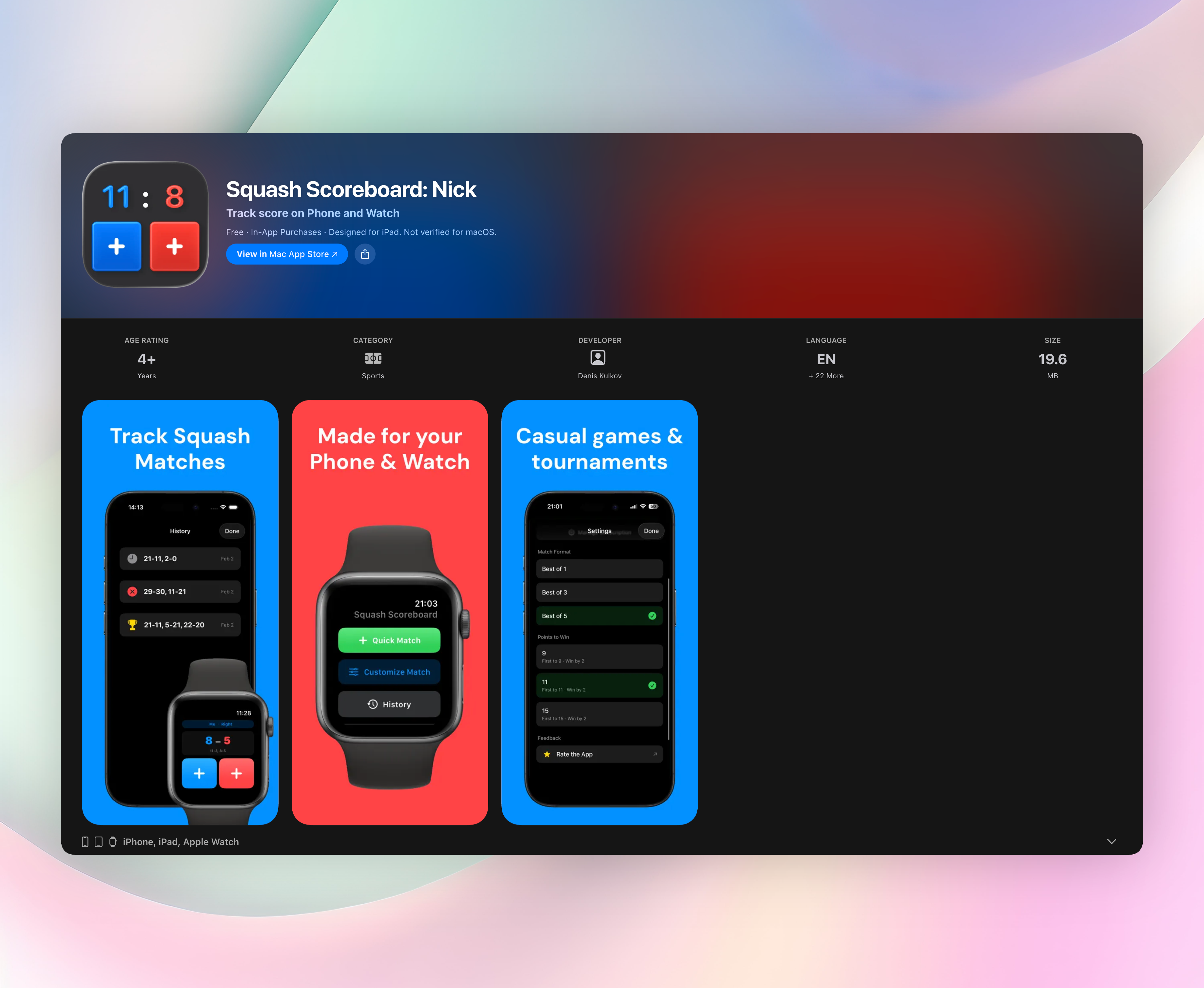
Both are all-or-nothing, so the score matters as much as the technique. At 9-9 in a game to 11, one attempted nick decides who serves for the game, and you can only review those calls afterwards if the scoreline was recorded as it happened — Squash Scoreboard is a squash scoreboard app for iPhone and Apple Watch that tracks match scores.
Picking two shots to drill
Adding all of these at once produces a player with eight bad shots. Pick two: drive and two-wall boast if you get pinned in the back corners, drop and volley if you win the middle but never finish, the lob if you're always out of position.
FAQ
What is a boast in squash?
A boast is any shot where the ball hits a side wall or the back wall before reaching the front wall, usually from a back corner into the opposite front corner. It's legal as long as the ball reaches the front wall above the tin without touching the floor first.
Is the boast an attacking or a defensive shot?
Both, depending on where you're standing. From the back corner under pressure it's defensive: you can't hit a good length, so you change direction instead. Played from the front as a trickle boast, or as a three-wall while your opponent is deep, it's an attack.
What is a nick in squash?
The nick is the junction where the side wall meets the floor. A ball landing exactly there rolls out flat and can't be returned. Miss by an inch and it pops up as an easy ball, which is what makes it the game's most attempted low-percentage shot.
Which types of squash shots should a beginner learn first?
The straight drive, then the cross court, then the boast. Length and width win far more club rallies than short shots, and every attacking shot works better once your opponent is pinned behind you.
Free Squash tools
- Squash Court Measurement CalculatorEnter a squash court plan's dimensions to create a clear checklist in metres, feet or inches for singles or doubles.
- Squash Racquet SelectorAnswer four fitting questions to get a squash racquet specification to shop with, plus reasoning and an alternative to try.
- Squash String Tension GuideChoose your playing standard, priority and string type, then compare your current tension with a practical squash recommendation in lb and kg.