Squash vs tennis: how the two racket sports really compare
Squash is faster and more physically punishing; tennis is more technical and easier to find a court for. Squash vs tennis comes down to two things: a 32-by-21-foot box versus a 78-foot court, and rallies that never stop versus points with recovery time written into the rules.
Squash vs tennis at a glance
| Squash | Tennis | |
|---|---|---|
| Singles playing area | 32 x 21 ft (9.75 x 6.4 m), enclosed | 78 x 27 ft (23.77 x 8.23 m), plus run-off |
| Venue | Purpose-built indoor court, booked by the hour | Indoor or outdoor, often public |
| Ball | Hollow rubber, dies fast, must be warmed up | Pressurized felt, bounces high and long |
| Serves per point | One | Two |
| Scoring | Point-a-rally to 11, win by 2 | 15/30/40, games, sets, tiebreaks |
| Match format | Best of five games | Best of three or five sets |
| Rest between points | Seconds; play is essentially continuous | Up to 25 seconds, plus changeovers |
| Racket | Roughly 110-145 g, max 686 mm long | Roughly 280-330 g strung, 27 in standard |
Court size, booking, and cost
A singles squash court is 32 feet long and 21 feet wide (9.75 x 6.4 m), enclosed on four sides, with the out line at 15 feet on the front wall and 7 feet on the back. A tennis singles court is 78 by 27 feet and needs run-off behind both baselines and down the sides, so one tennis court and its surround swallows several squash courts' worth of floor. Those squash court dimensions drive almost everything else.
The practical consequence is availability. Squash needs a built indoor court, so you book a 40- or 45-minute slot and the peak evening ones go early. Tennis often has public courts you can turn up to, though indoor tennis in winter gets expensive. Squash plays the same in January as in July; tennis swings with the weather, and so does your volume.
The ball is the real difference
A tennis ball is pressurized and keeps bouncing all afternoon. A squash ball is hollow rubber, and cold it barely bounces at all — you have to hit it for several minutes before it plays properly. Speed is graded by colored dots: double yellow is the slowest and the competition standard, single yellow slightly livelier, red and blue considerably bouncier. Starting a beginner on a double yellow is the most common reason someone tries squash once and never comes back; a squash ball for beginners should be red or blue.
That dying ball is why squash shot-making is about length and tightness rather than pace. Put the ball into a back corner and it stays there. In tennis, a deep ball still bounces up into a hitting zone, so depth pressures your opponent but rarely ends the rally outright.
Rally length and cardiovascular intensity
Squash play is close to continuous. A rally ends, the loser walks two steps, and the next serve goes in within seconds. Movement is a lunge out from the T, a push back to the T, repeat, always from a standing start — the sport is built from accelerations and stops rather than running. Calves, Achilles tendons, and hip flexors take the load.
Tennis puts more distance on your legs but hands you recovery: the rules allow up to 25 seconds between points and 90 seconds at changeovers, and the ball is in play for only a fraction of the match. In squash the work-to-rest ratio beats you first — beginners are gassed long before their technique fails.
Scoring: points to 11 versus games, sets, and deuce
Squash uses point-a-rally scoring: every rally scores for whoever wins it, games run to 11, and at 10-10 you play on until someone leads by two. Matches are best of five games. Older English scoring — hand-in, hand-out to 9, where only the server could score — still turns up in club play, so agree on which squash scoring you're using before the knock-up.
Tennis stacks three layers: points counted 15, 30, 40, game; games won six with a margin of two, tiebreak at 6-6; and sets above that. Deuce and advantage give a single game an open-ended tail, though plenty of leagues now use no-ad scoring, and final-set formats vary by event.
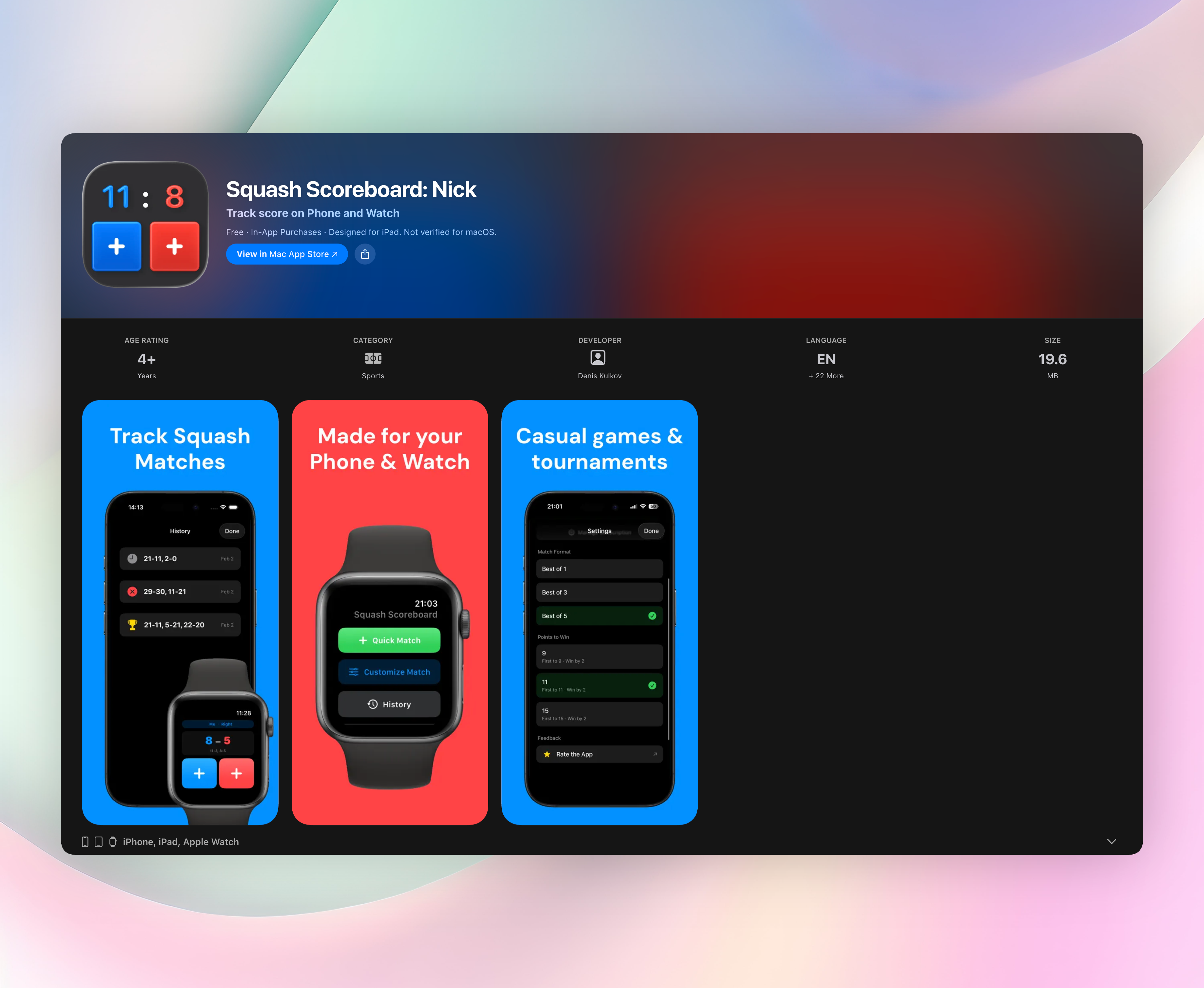
Squash's every-rally-scores model is far simpler to keep live than tennis's games and sets, which is why a single screen is enough for it — two numbers and a marker for who's serving. Squash Scoreboard is a squash scoreboard app for iPhone and Apple Watch that tracks match scores, which fits the format: one tap per rally.
How much technique transfers between the two
Both directions transfer partially, and both trip on swing length.
Coming from tennis, your hand-eye coordination and competitive instincts carry over. The stroke doesn't. A squash racket weighs less than half what a tennis racket does, and the swing is compact — cocked wrist, open face, cutting under the ball to control length. Tennis converts swing too big, hit too flat, and leave the ball floating mid-court where it gets volleyed.
Squash players going the other way arrive with unusually good hands and slice, then hit the mirror-image problems: producing topspin with a long low-to-high swing, timing a ball that's still rising off the bounce, and recovering to a baseline position rather than a central T. The tennis serve, a full overhead throwing motion with a toss, has no squash equivalent. Grips are the other snag — squash is played largely off one grip, tennis changes grip by the shot.
Squash vs badminton and squash vs handball
Walls are the dividing line. Squash vs badminton is angles against airtime: badminton is played over a net on a 44-by-20-foot doubles court, the shuttle decelerates hard so overhead power and deception decide points, and games run to 21, win by two, capped at 30, best of three. Badminton spreads the work across jumping and lunging in open space; squash concentrates it in repeated lunges out of the T, on a floor you share with your opponent.
Squash vs handball is a closer comparison than it sounds, if you mean four-wall handball rather than the Olympic team sport. It uses a 40-by-20-foot court and the same read-the-rebound instincts, but your reach is an arm instead of 27 inches of frame, so the court plays much bigger. Handball players pick up squash's wall geometry quickly and the racket slowly.
Is squash hard to learn compared with tennis?
The curves are shaped differently. Squash's first session is friendlier — light racket, ball in front of you, and you can rally against the front wall alone. The wall you eventually hit is stamina and the dead ball: sustaining a rally means hitting accurate length over and over, and with the wrong ball you'll spend more time picking it up than hitting it. Choose a bouncier ball and squash difficulty drops sharply.
Tennis is harder in month one — the serve alone takes months to become reliable — but baseline rallying is more forgiving once you can make contact, because the ball arrives at a comfortable height.
Two squash-specific rules matter early: both players share the floor, so let and stroke rules handle interference, and most federations require eye protection for juniors and in doubles.
FAQ
Is squash harder than tennis?
Squash is harder physically; tennis is harder technically. Most people can rally in squash on day one but are exhausted within 20 minutes. Tennis takes longer to reach a playable rally, especially the serve, but paces you better once you're there.
Can a tennis player switch to squash easily?
Movement and competitive habits transfer; the swing does not. Expect a few weeks of shortening your stroke and learning to cut under the ball instead of driving through it.
Which is a better workout, squash or tennis?
Squash packs more work into less time, since there's almost no dead time between rallies. Tennis covers more ground over a longer match. Forty minutes of hard squash and 90 minutes of singles tennis are different kinds of tired.
Do you get two serves in squash like in tennis?
No. Squash gives you one serve — a fault loses the rally outright, so servers play a safer, higher-percentage serve than a tennis first serve. Tennis's two-serve structure is what makes the big first serve worth the risk.
Free Squash tools
- Squash Court Measurement CalculatorEnter a squash court plan's dimensions to create a clear checklist in metres, feet or inches for singles or doubles.
- Squash Racquet SelectorAnswer four fitting questions to get a squash racquet specification to shop with, plus reasoning and an alternative to try.
- Squash String Tension GuideChoose your playing standard, priority and string type, then compare your current tension with a practical squash recommendation in lb and kg.