Squash vs racquetball: how the two sports really differ
Squash vs racquetball comes down to three things: the court, the ball, and the scoring. Squash uses a 32 × 21 ft court with a tin and a nearly dead ball, scoring every rally to 11. Racquetball uses a 40 × 20 ft court, a live front wall, and points only for the server.
Squash vs racquetball at a glance
| Squash (singles) | Racquetball (singles) | |
|---|---|---|
| Court | 32 × 21 ft (9.75 × 6.4 m) | 40 × 20 ft (12.2 × 6.1 m) |
| Front wall in play | Between the tin and the 15 ft out line | Floor to ceiling, the full 20 ft |
| Tin | Yes — 19 in standard, 17 in at PSA events | None |
| Ceiling | Out | In play |
| Ball | ~40 mm, 23–25 g, graded by dot color | 2.25 in (57 mm), ~1.4 oz, lively out of the can |
| Racket | Up to 686 mm (27 in), narrow head | Up to 22 in, wide head, wrist cord required |
| Who can score | Either player, every rally | Server only |
| Game | 11 points, win by 2 | 15 points, win by 1 |
| Match | Best of 5 | Best of 3, third game to 11 |
| Serves | One | Two in USA Racquetball sanctioned play, one on the pro tours |
| Eye protection | Required for juniors and doubles by most federations | Required |
Squash court vs racquetball court
A singles squash court is 9.75 m by 6.4 m — 32 by 21 ft. A racquetball court is 40 by 20 ft: eight feet longer, a foot narrower, a true 20 ft box with a playable ceiling and a back wall at least 12 ft high, usually glass.
The markings say more than the footprints. Squash puts its lines on the walls: the tin along the bottom of the front wall, a service line at 1.78 m, a front out line at 4.57 m (15 ft), a back out line at 2.13 m (7 ft), and a side line sloping between them. The floor carries only the short line, 5.44 m from the front wall, and two 1.6 m service boxes — more in the squash court dimensions breakdown.
Racquetball reverses that. Its walls are bare and every line is on the floor: the short line splitting the court at 20 ft, a service line 15 ft from the front wall making a five-foot service zone, a dashed receiving line five feet behind the short line, and drive serve lines three feet in from each side wall.
The tin, the out lines, and the ceiling
The tin shapes everything else. It's a strip across the bottom of the front wall — 0.48 m (19 in) in the standard specification, 0.43 m (17 in) at PSA events. Hit it and the rally is over, so every drop and kill in squash is played with margin above a barrier.
Racquetball has no tin, so the front wall is live down to the floor. That's why the rollout — a ball striking the seam where wall meets floor and rolling out dead — is its signature winner. In squash, that shot is simply down.
The upper boundary flips too. Squash is a bounded box: above the 15 ft front line, the 7 ft back line, or the slope between them, the ball is out. Racquetball has no out lines inside the court, and the ceiling is a legal surface: the standard defensive reset is a ceiling ball, ceiling first then front wall, dropping deep into the back court. Squash's equivalent is a high, tight rail into the back corner; touch the ceiling and you've lost the rally.
Squash ball vs racquetball: two different objects
The racquetball is bigger at 2.25 in across, against roughly 40 mm for a squash ball, and far livelier. Drop a racquetball from shoulder height and it comes back toward your waist. Drop a cold double-yellow squash ball and it barely clears your ankle, which is why squash players spend the first minutes of a session hitting into the same corner.
Squash balls are graded by dot color, from the slow double yellow used at professional level up through single yellow, red, and blue, which get progressively bouncier. Beginners who start on a double yellow usually decide the sport is impossible; a red or blue fixes that in one session, and the squash ball for beginners guide covers which to buy.
The rackets follow the balls. A squash racket runs up to 686 mm (27 in) with a narrow head and a strung area capped at 500 cm². A racquetball racket is capped at 22 in including the handle, with a wide head and a mandatory wrist cord.
Squash vs racquetball rules: serving and interference
Serving is where the squash vs racquetball rules split first. In squash you get one serve: keep part of one foot inside a service box, strike the ball out of the air without letting it bounce, hit the front wall between the service line and the out line, and land it in the opposite back quarter unless the receiver volleys it. Fault under point-a-rally scoring and you lose the rally.
Racquetball serves from the zone between the 15 ft and 20 ft floor lines. The server bounces the ball once, then hits it to the front wall; it must reach the front wall first and rebound past the short line, and it may catch one side wall on the way. A serve that touches the ceiling, or that carries to the back wall before bouncing, is a fault, and two faults in a row is a sideout. USA Racquetball's sanctioned play gives the server two chances, the way tennis does; the pro tours and a few national-team divisions play one.
Interference splits too. Squash uses lets, which replay the rally, and strokes, which award it: the striker is owed a fair path to the ball and a reasonable swing. Racquetball calls hinders, which replay, and avoidable hinders, which cost the offender the rally.
Scoring: every rally versus server only
Squash uses point-a-rally scoring. Every rally is a point for whoever won it, games go to 11, and at 10–10 you play on for a two-point margin, with matches best of five. Older English scoring — hand-in, hand-out to 9, where only the server scores — still turns up in club leagues, so ask before you start; the squash scoring rules cover both.
Racquetball kept the server-only model. When the receiver wins a rally it's a sideout: the serve changes hands and nobody scores. Games run to 15, win by one, best of three, with the third game to 11.
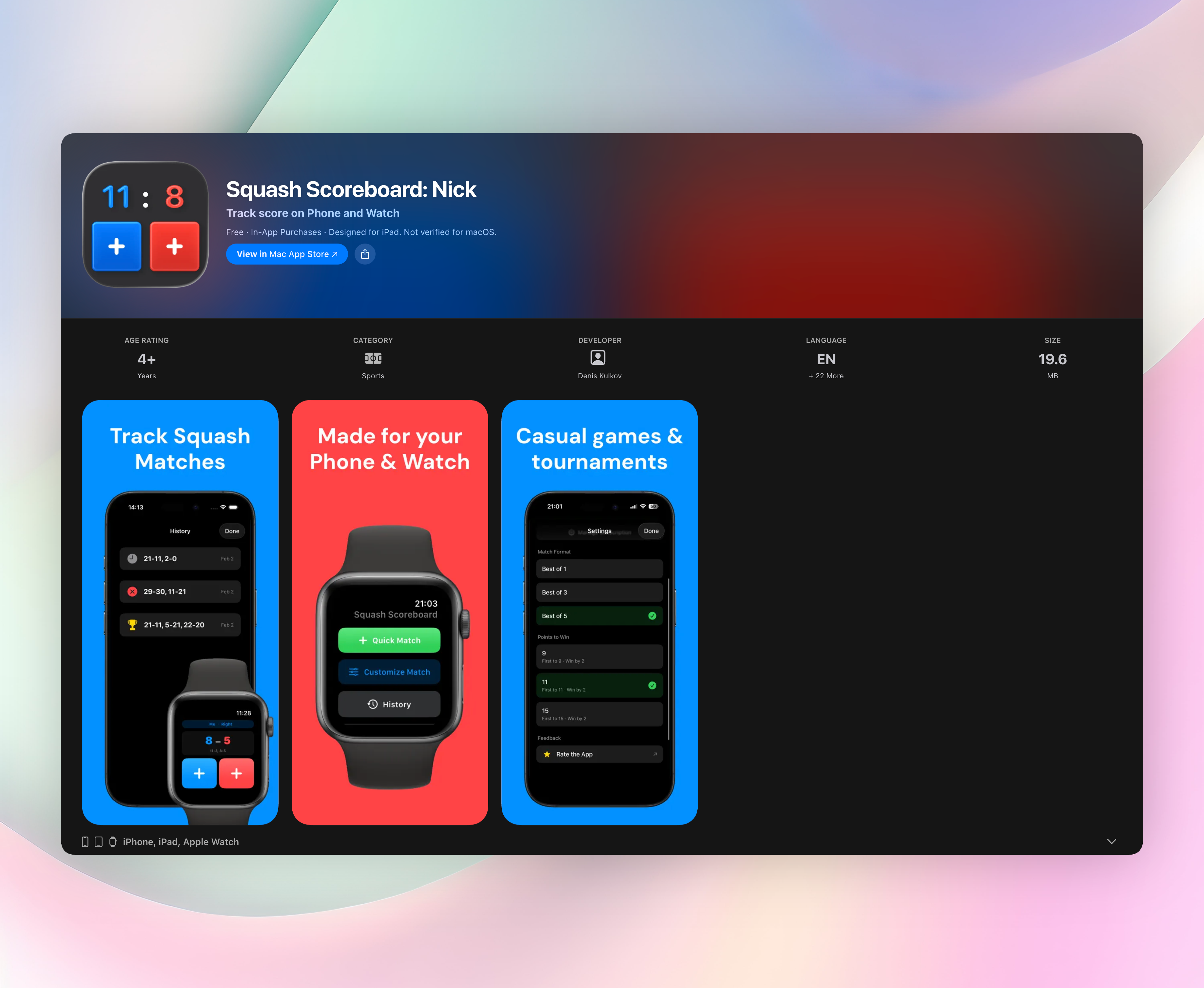
So the two sports need different scoreboards. A racquetball scoreboard has to know who's serving before it can decide whether a rally is worth anything, while a squash scoreboard credits every rally to whoever won it. Squash Scoreboard is a squash scoreboard app for iPhone and Apple Watch that tracks match scores.
Can you play squash on a racquetball court?
Not as a real game. The court is eight feet too long and a foot too narrow, with no tin, no out lines, no squash service boxes, and a ceiling that's in play. The ball dies before it reaches the back wall, and nothing punishes a low kill. For solo drilling it's fine if the club allows it — some don't, because squash balls mark walls.
Clubs do convert racquetball courts, but that's construction, not line painting: a new back wall built forward to bring the length to 32 ft, a tin and wall lines on the front wall, and a side wall moved out for the extra foot of width. It usually happens when a club rebuilds a whole bank of courts.
Which one should you play?
Racquetball is easier on day one: a lively ball, the whole front wall as a target, and the ceiling as a safe out under pressure. Beginners build real rallies within an hour, and points are short and explosive.
Squash takes longer to become fun. Nothing works until the ball is warm and you can keep it above the tin and tight to the side wall. The reward is longer rallies and constant repositioning around the T. The racquetball vs squash choice in one line: squash punishes loose length, racquetball punishes slow feet.
Access usually settles it. In the US, racquetball courts are far more common in commercial gyms, while squash lives in racquet clubs and universities; outside North America that ratio flips. Squash also joins the Olympic program at Los Angeles 2028.
Crossovers hit predictable walls: players coming from racquetball aim low and feed the tin; squash players leave the ceiling unused.
FAQ
Is squash harder than racquetball?
Squash is harder to start. A cold ball doesn't bounce, so early rallies collapse until it warms up and your length improves, and the tin removes the easy low winner. Racquetball's live ball and floor-to-ceiling front wall make the first sessions more rewarding.
Can you play squash on a racquetball court properly?
You can hit in one, but you can't play a real match: 40 ft long instead of 32, a foot narrower, no tin, no out lines, no squash service boxes. Some clubs also ban squash balls because they mark racquetball walls.
Is a squash ball the same as a racquetball?
No. A racquetball is 2.25 in across and bouncy straight out of the can; a squash ball is roughly 40 mm, weighs 23–25 g, and has to be warmed up before it plays properly. Squash balls carry a standardized dot grading for speed.
Which is a better workout, squash or racquetball?
Both are demanding, and they load you differently. Squash rallies last longer and keep you moving between the T and the corners — a more sustained aerobic effort. Racquetball is stop-start: shorter points, harder swings, more lunging.
Can I use my squash racket for racquetball?
No. Racquetball caps racket length at 22 inches and requires a wrist cord, so a 27-inch squash frame is illegal and isn't built for a heavier, faster ball. Bring eye protection too — it's required in sanctioned play.
Free Squash tools
- Squash Court Measurement CalculatorEnter a squash court plan's dimensions to create a clear checklist in metres, feet or inches for singles or doubles.
- Squash Racquet SelectorAnswer four fitting questions to get a squash racquet specification to shop with, plus reasoning and an alternative to try.
- Squash String Tension GuideChoose your playing standard, priority and string type, then compare your current tension with a practical squash recommendation in lb and kg.