Squash history: from Harrow School to the modern game
Squash history starts at Harrow School in England around 1830, when boys waiting for a rackets court hit a punctured ball that squashed flat against the wall instead of springing off it. Nobody invented the game in one moment. Harrow built the first four purpose-built courts in 1864.
Where squash was invented, and who invented it
Rackets came first — a hard, fast wall game usually traced to London's debtors' prisons in the 18th century and then taken up by English public schools. Harrow had rackets courts and far more boys than court time, so the queue knocked a ball around against whatever wall was free.
A punctured rackets ball behaves nothing like a sound one. It squashes on impact, dies off the front wall, and stops rewarding raw pace. Retrieving, angles, and length start to matter instead. That accident is the squash origin, and it explains why no single name owns the invention: the game was assembled by schoolboys over a couple of decades and written down much later.
The honest answer to who invented squash is therefore collective — Harrow pupils in the 1830s. The school formalized it in 1864 with four courts of its own. Standard rules took another 60 years, by which time the game had spread far enough to develop in two directions at once.
Key dates in squash history
- c. 1830 — Harrow boys play with a punctured rackets ball against school walls.
- 1864 — Harrow builds four purpose-built courts.
- 1884 — the first North American court goes up at St Paul's School in Concord, New Hampshire.
- 1904 — the United States Squash Racquets Association forms in Philadelphia, the earliest national association in the sport.
- 1928 — the Squash Rackets Association forms in England and takes charge of the rules; the 21-foot-wide court becomes the English standard.
- 1967 — the International Squash Rackets Federation is founded, renamed the World Squash Federation in 1992.
- 1989–2003 — world championships are played point-a-rally to 15.
- 2000 — the double-yellow-dot ball becomes the competition standard.
- 2004 — the professional game switches to point-a-rally to 11.
- 2009 — PAR-11 is ratified for all levels worldwide.
- 2015 — the women's tour merges into the PSA, putting both professional tours under one organization.
- 2028 — squash is on the Olympic program in Los Angeles.
Hardball squash: the North American branch
North America got the game early and then took it somewhere else. Courts built there were narrower — 18½ feet against England's 21 — and players used a hard rubber ball that stayed lively in cold, unheated buildings. Faster ball, tighter court, lower tin: the result was a power game of straight drives and kill shots, scored point-a-rally to 15 instead of by the English server-only method.
| Hardball singles | International singles | |
|---|---|---|
| Court width | 18½ ft (5.6 m) | 21 ft (6.4 m) |
| Court length | 32 ft (9.75 m) | 32 ft (9.75 m) |
| Tin height | 17 in (43 cm) | 19 in (48 cm) |
| Ball | hard rubber, fast, high bounce | soft, 39.5–40.5 mm, very low bounce |
| Scoring | point-a-rally to 15 | 9-point hand-in hand-out, now PAR-11 |
| Played today | singles effectively gone | the world game |
The court dimensions are the clearest fingerprint of which code a room was built for. An old 18½-foot box is a hardball court no matter what lines have been repainted on it since.
Doubles is the branch that survived. Hardball doubles is played by four on a much larger court, 45 by 25 feet, and it still has a live club and tournament scene in the United States and Canada.
How North America joined the international game
There is no single date for the changeover. American associations began recognizing the wider court in the 1980s, clubs built or converted to 21 feet, and by the mid-1990s most North American players had moved across to the international game. Hardball singles was never abolished; it ran out of opponents, courts, and ball supply.
The professional side consolidated later. The women's tour merged into the PSA on 1 January 2015, so one organization now runs both tours under one set of rules.
Ball standardization and what the dots mean
Two changes shaped modern play more than any lets-and-strokes argument, and both are easy to skip in the history of squash as a sport. The first is the ball. A regulation ball is 39.5–40.5 mm across and weighs 23–25 grams, and speed is marked by a colored dot: blue fastest, then red, green, single yellow, and double yellow slowest, with an orange ball for high altitude. The double-yellow dot became the competition standard in 2000.
That matters more than it sounds. A slower ball dies in the back corners, so rallies run longer and the court plays bigger than its 21 feet. Picking the wrong dot is still the most common reason a beginner's rallies collapse after two shots.
From hand-in hand-out to PAR-11 scoring
The second change is scoring. Under traditional English scoring — hand-in hand-out — only the server could score, games went to 9, and at 8-all the receiver chose whether to play to 9 or 10. Matches ran to unpredictable lengths, which suited clubs and ruined broadcast schedules. World championships used point-a-rally to 15 from 1989 to 2003.
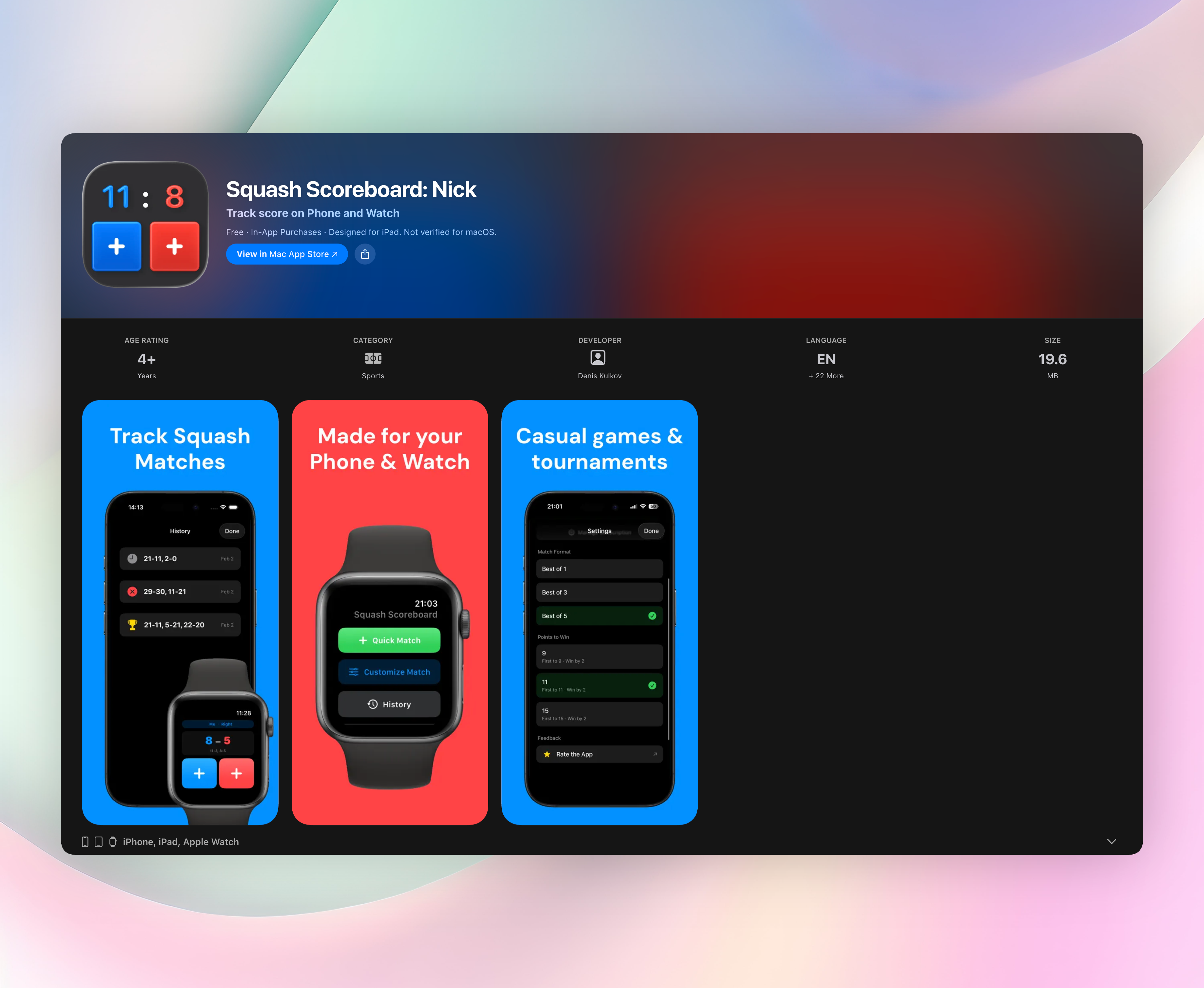
PAR-11 replaced it: a point on every rally, games to 11, win by two, best of five. The professional tour adopted it in 2004 and it was ratified worldwide in 2009, which is why anyone who started after that has never kept score another way. Squash Scoreboard, a squash scoreboard app for iPhone and Apple Watch that tracks match scores, counts the modern PAR-11 game the pros switched to in 2004.
FAQ
Who invented squash?
No one person did. Pupils at Harrow School in England worked it out in the 1830s, hitting a punctured rackets ball against walls while they waited for a rackets court. The school built four dedicated courts in 1864, but the rules were not standardized until the 1920s.
Where was squash invented?
At Harrow School, northwest of London. The first court in North America followed at St Paul's School in Concord, New Hampshire, in 1884, and the United States Squash Racquets Association, formed in Philadelphia in 1904, was the sport's first national association.
What is hardball squash?
The North American version played on a narrower 18½-foot court with a hard, fast ball and a 17-inch tin, scored point-a-rally to 15. Singles has all but disappeared since North America moved to the international game in the 1990s. Hardball doubles, played by four on a 45-by-25-foot court, is still going.
When did squash switch to PAR-11 scoring?
The professional game switched in 2004; PAR-11 was ratified for all levels worldwide in 2009. Before that, the standard was 9-point hand-in hand-out scoring, with point-a-rally to 15 used at world championships between 1989 and 2003.
Is squash an Olympic sport?
It is on the program for the 2028 Games in Los Angeles. It had never been contested at an Olympics before, despite repeated bids in earlier cycles.
Free Squash tools
- Squash Court Measurement CalculatorEnter a squash court plan's dimensions to create a clear checklist in metres, feet or inches for singles or doubles.
- Squash Racquet SelectorAnswer four fitting questions to get a squash racquet specification to shop with, plus reasoning and an alternative to try.
- Squash String Tension GuideChoose your playing standard, priority and string type, then compare your current tension with a practical squash recommendation in lb and kg.