Squash equipment checklist, with the numbers that matter
Four things get you on court: a racket, a ball, non-marking indoor shoes, and eye protection. That's the whole squash equipment list — everything else can wait a season. The two decisions that change how the game feels are racket weight and which ball you buy.
What squash equipment you actually need, in priority order
Shoes decide whether your ankle survives a front-corner lunge. Eyewear decides whether your eye does. The racket decides how the ball feels, and the ball decides whether rallies happen at all. If you haven't played yet, the beginner's guide to squash covers the swing and the court.
Squash racket weight, balance, and head shape
Rackets are sold by unstrung frame weight, usually between 110 g and 145 g; string and a grip add roughly 15–25 g. The rules cap a strung racket at 255 g, 686 mm long and 215 mm wide, so any squash racket size guide comes down to a narrow window — every legal frame sits inside it.
- 110–125 g — light. Fastest through the swing and most forgiving of late preparation, with less free power.
- 125–135 g — the middle, where most club players settle.
- 135–145 g — heavy. More plow through the ball, harder to bring around in time.
Balance matters as much as the number. A head-light frame carries its mass in the handle, so the head travels faster for the same effort. Beginners are almost always late — the ball arrives before the racket is ready — and a head-light 120 g frame rescues that swing. Head-heavy frames reward the opposite: a compact, early swing a first-year player doesn't have yet.
Head shape is the other split. Teardrop frames run the strings to the top of the head, giving a longer string bed and a bigger sweet spot. Classic bridged frames have a smaller head: more feedback, less forgiveness. Start teardrop. Grip size isn't really a decision — handles come in one size, and you build thickness up with overgrips.
Squash racket string tension
Squash tensions run far lower than tennis: roughly 22–28 lb is the usable range. Around 22–24 lb the string bed is deeper and springier, with more power and more forgiveness off-center. At 26–28 lb it plays flatter and more controlled, but gives up power and string life. Most beginners are better served low.
The strings are thin, typically 1.20–1.25 mm multifilament; thinner string feels better and breaks sooner. Factory string on an entry-level frame is a cost item, not a performance item. Replacing it is a real upgrade — just not in your first month, when you can't tell tension from technique.
Which squash ball to buy, and why not double yellow
A standard squash ball is about 40 mm across and weighs around 24 g. The colored dot marks its speed and bounce, and it's the item beginners get wrong most often.
| Dot | Bounce and speed | Warm-up needed | Who it suits |
|---|---|---|---|
| Double yellow | Lowest bounce, slowest | Several minutes of hard hitting | Match play, sustained rallies |
| Single yellow | Slightly livelier | A few minutes | Improvers, cold courts |
| Red | Higher bounce, faster | Very little | Beginners, casual games |
| Blue | Highest bounce, fastest | None to speak of | First sessions, juniors |
The warm-up is the whole argument. A double yellow only bounces properly once it's hot, and it gets hot from sustained hitting. Two beginners trading three shots at a time never get there, so the ball dies on the second bounce, every rally ends early, and both players conclude they're bad at squash. Start on blue or red, move to single yellow when you can keep a rally going down the wall, and buy double yellows when warming one up stops being a chore. The full grading is in what the dots on a squash ball mean.
Balls don't wear out gradually — they split. Keep a spare in the bag.
Squash shoes: gum soles, non-marking, indoors only
Court shoes for squash need a non-marking gum rubber outsole. Most clubs enforce it, because a marking sole leaves black streaks a wooden floor doesn't shed. If the sole is black, assume you'll be asked to change.
Past the sole, indoor court shoes are built for a load running shoes aren't. Squash is lateral, and the front-corner lunge puts weight on the outside edge of the foot. Running shoes have tall, soft midsoles that roll under that load and almost no torsional stiffness. A court shoe sits low, with a firm midsole and a reinforced medial side.
Fit them snug through the midfoot — your foot slides forward into the toe box on every lunge — and keep them indoors; grit from the walk to the club turns a non-marking sole into a marking one.
Squash eye protection is equipment, not an accessory
A squash ball is small enough, and deforms enough on impact, to reach the eye rather than be stopped by the bony rim of the socket. What to look for:
- Polycarbonate lenses in a wraparound frame that covers the outer corner of the eye.
- A standards marking on the frame or lens — ASTM F803 is the common one, with regional equivalents elsewhere.
- An anti-fog coating, plus a headband so you aren't wiping the inside of the lens with a damp shirt, which scratches the coating.
Prescription glasses and sunglasses are not protective eyewear: the lenses and frames aren't impact-rated, and broken lens material makes an injury worse. Contact lenses protect nothing.
Rules vary by governing body. Junior competition generally requires certified eyewear, and doubles requires it under the WSF doubles rules, where four players and two swinging rackets share one court. Club and league rules differ, so check yours. Replace eyewear after a direct ball strike or once the lens is scratched.
Squash grip tape: replace by hours, not months
Two products get called grip tape. A replacement grip is thicker, has an adhesive backing and goes onto the bare handle. An overgrip is thin and cheap and wraps over whatever is there. Towel grips absorb more sweat and go through faster; polyurethane grips turn slick rather than soggy.
Use hours as the trigger, not the calendar: a polyurethane replacement grip is usually past it around 20–30 hours on court, an overgrip after 8–12. Sweat rate moves both numbers a long way.
The reliable signal is your hand. When you start squeezing harder to stop the handle rotating on a hard forehand, it's done — and a tight grip kills wrist speed and produces forearm fatigue that gets blamed on technique. Layering overgrips is also the fix for a handle that feels thin.
What to skip for the first six months
- A second racket. Matched pairs matter once a broken string can end a league game. Before that, one frame is plenty.
- A restring. If the factory string hasn't broken, you don't yet have an opinion about tension worth paying for.
- A six-racket thermal bag. You own one racket, a tube of balls and a pair of shoes.
- A pro-grade ball. The most common first purchase, and one of the most common reasons beginners quit.
- Anything sold as arm-saving. Squash elbow comes from a slick grip and a late swing, not a missing gadget.
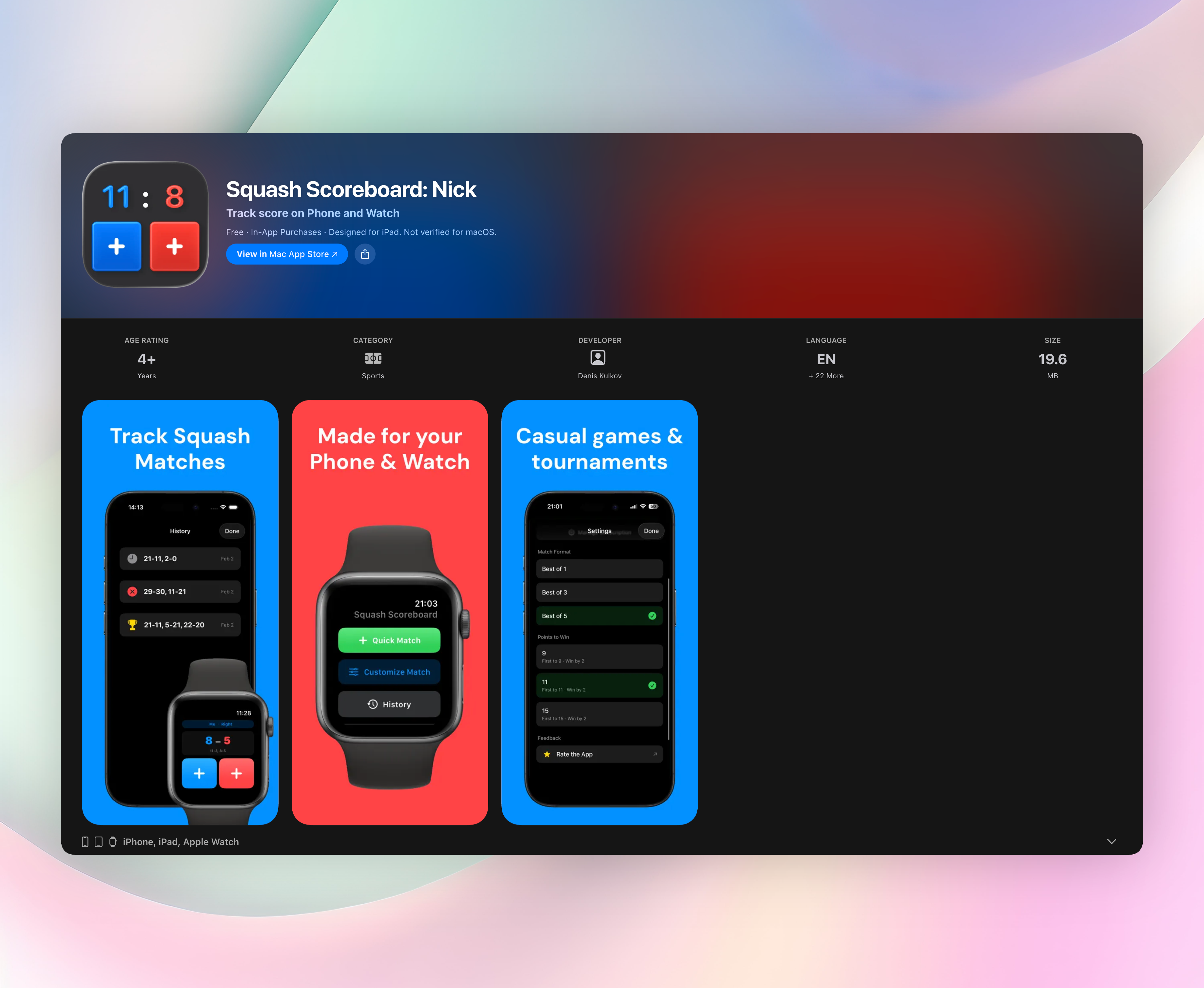
The last piece to sort is scoring, and it needs no equipment — Squash Scoreboard is a squash scoreboard app for iPhone and Apple Watch that tracks match scores, so once the kit is settled the only thing left to think about is the ball. Useful while PAR-11 scoring is still new to you.
FAQ
What do you need to play squash?
A racket, a ball, indoor court shoes with a non-marking sole, and protective eyewear. Many clubs rent or lend rackets and balls for a first session, so shoes are the one thing worth bringing yourself. Ordinary sports clothing is fine.
Do I really need squash eye protection?
Junior competition and doubles require certified eyewear under most rule sets, and it's sensible in every other game. Eye injuries in squash usually come from a racket or a ball you never saw, which is the situation reflexes can't help with.
What squash ball should a beginner use?
A blue or red dot. Both bounce higher and stay lively without a long warm-up, which keeps rallies going while your hitting is inconsistent. Move to single yellow once you can hit ten shots in a row down the wall.
Can I wear running shoes on a squash court?
Better not to. Running soles are often marking, which many clubs won't allow, and the tall soft midsole rolls sideways under a lunge — the exact movement squash asks for constantly.
How often should I replace squash grip tape?
Go by hours played: roughly 20–30 hours for a polyurethane replacement grip and 8–12 for an overgrip, sooner if you sweat heavily or use a towel grip. Change it as soon as you notice yourself gripping harder to stop the handle turning.
Free Squash tools
- Squash Court Measurement CalculatorEnter a squash court plan's dimensions to create a clear checklist in metres, feet or inches for singles or doubles.
- Squash Racquet SelectorAnswer four fitting questions to get a squash racquet specification to shop with, plus reasoning and an alternative to try.
- Squash String Tension GuideChoose your playing standard, priority and string type, then compare your current tension with a practical squash recommendation in lb and kg.