Racketball rules: what squash 57 changes from squash
Racketball rules depend on which racketball you mean. In Britain it's now called Squash 57: a standard squash court, a 57mm low-compression ball, two serves, PAR scoring to 11. In the US, "racketball" means racquetball — a longer court with the ceiling in play.
Two games, one name
Ian Wright created British racketball in 1976 by taking American racquetball and fitting it to the squash courts Britain already had. It kept the fat ball and the short racket, lost the ceiling, and inherited the squash court's tin and out lines. The World Squash Federation rebranded it Squash 57 in 2016, after the ball's diameter, to end the confusion with the American game.
The new name hasn't fully replaced the old one. Racketball in the UK still fills club box leagues and county leagues under both labels. Everything below is the Squash 57 rulebook; where the American game differs, I flag it.
Racketball rules: what changes from squash
Three things change — the ball, the racket, and the serve. Nearly everything else is the squash rulebook, unedited.
The ball
The Squash 57 ball is 57mm ±1mm across and weighs 40g ±1g, against 39.5–40.5mm and 23–25g for a squash ball. Size isn't really the point; compression is. A squash ball stays dead until you've warmed it for several minutes, while the 57 ball comes off a cold front wall on the first rally and keeps rebounding off the back wall. That one property is what makes the game quick to pick up.
The WSF lists two grades: blue, the higher-bounce ball suited to beginners and social players, and black, the lower-bounce ball favored by stronger players who want rallies to end. Manufacturers also sell an intermediate ball. The idea matches squash ball dots, shifted up the bounce scale.
The racket
Squash 57 rackets are capped at 558.8mm (22 inches); a squash racket can run up to 686mm. Five inches of reach disappear, the swing arc shortens, and the head is usually rounder and thicker. Your squash racket isn't legal in a sanctioned Squash 57 match.
The serve
Two changes, both favoring the server.
You get two serves. Fault the first and you serve again, as in tennis. Two consecutive faults is a hand-out, and under PAR scoring your opponent takes the point.
There's no service line to clear. A squash serve has to hit the front wall above the cut line at 1.78m. In Squash 57 the whole front wall between the tin and the out line is legal, so a hard, flat serve into the side wall becomes a genuine weapon.
The rest is squash. One foot in the service box, the ball has to rebound into the opposite back quarter unless the receiver volleys it, tin and out lines apply as normal. One quirk: the ball is dropped or thrown to the floor and must bounce once before you strike it — you can't serve it straight out of your hand. Beyond that, the squash serve rules transfer intact.
Scoring
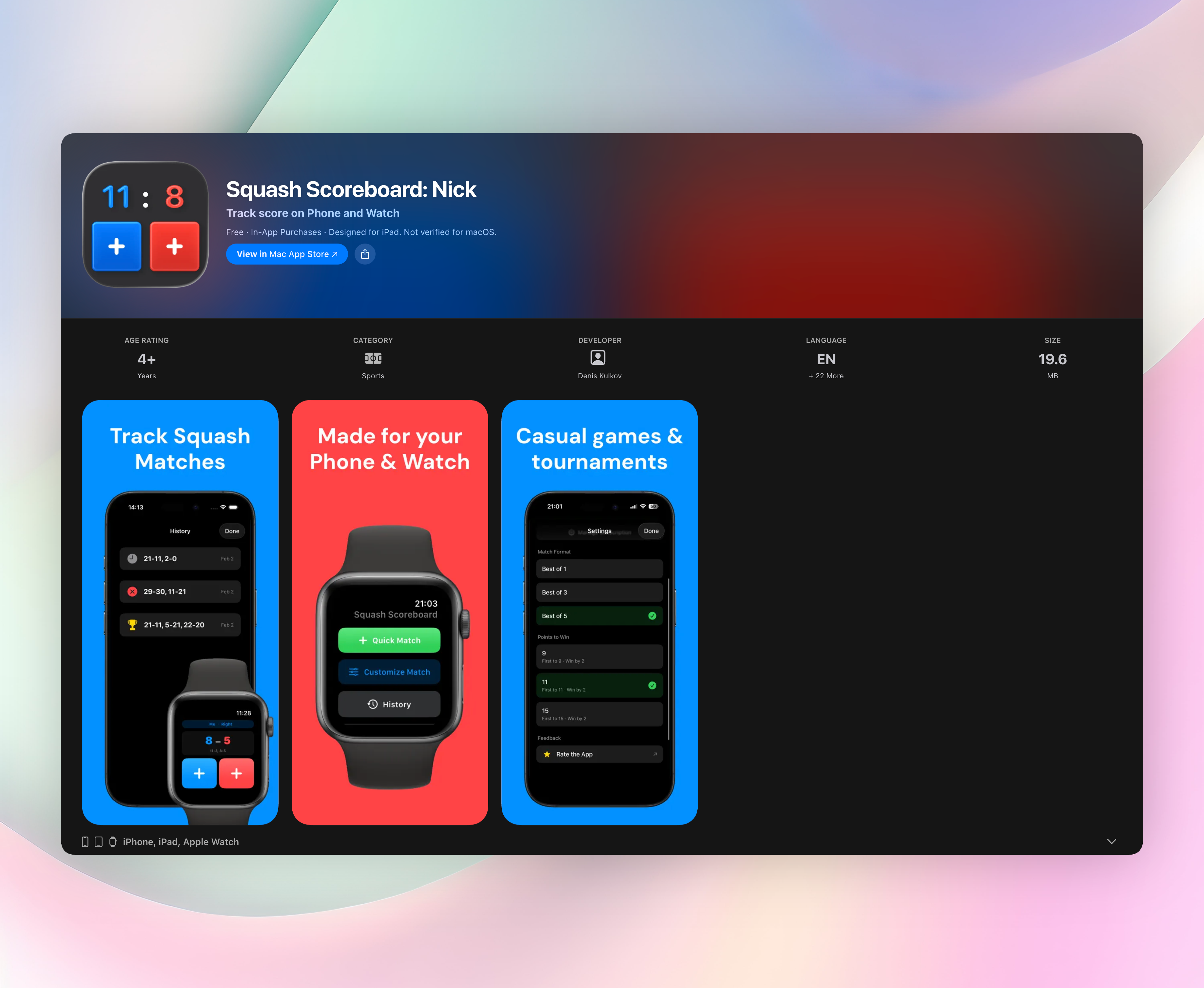
Point-a-rally to 11, win by two from 10-all, best of five games; some events use best of three. That's the modern squash system with nothing removed, so PAR 11 scoring needs no translation. Because Squash 57 scores PAR to 11 best of five, the same scoreboard runs both games without a settings change — Squash Scoreboard is a squash scoreboard app for iPhone and Apple Watch that tracks match scores, and a racketball match reads identically to it.
What doesn't change
Lets, strokes and no-lets are the squash interference rules, word for word. One bounce. Every return above the tin. The court, the markings and the 19-inch tin are the ones already painted on the wall.
Racketball vs squash vs American racquetball
| Squash 57 (British racketball) | Squash | Racquetball (US) | |
|---|---|---|---|
| Court | 9.75 × 6.4 m (32 × 21 ft) | Same court | 40 × 20 ft |
| Roof | Out; front wall out line at 4.57 m | Out | Ceiling in play, 20 ft |
| Ball | 57mm, 40g, low compression | 39.5–40.5mm, 23–25g | 57mm (2.25 in), ~1.4 oz, high bounce |
| Racket max length | 558.8mm (22 in) | 686mm (27 in) | 22 in |
| Scoring | PAR to 11, win by 2 | PAR to 11, win by 2 | Server only scores, games to 15 |
| Match | Best of 5 (or 3) | Best of 5 | Best of 3, 11-point tiebreaker |
| Serve attempts | Two | One | Two (one at some elite events) |
| Serve target | Front wall between tin and out line | Front wall above the 1.78 m service line | Front wall first, rebound past the short line |
The two balls share a diameter and roughly a weight; the racquetball is far livelier, which the longer court and the ceiling absorb.
What transfers from your squash game
Movement transfers whole — the T, the split step, the recovery habits. Length doesn't. A ball hit to a good squash length sits down in the back corner; the 57 ball rebounds off the back wall into a comfortable hitting position and hands your opponent the rally. You have to hit lower and harder, take width off the side wall, or bring the ball short.
Drops still work, but the extra bounce means the ball sits up, so they need to be tighter. Boasts get better, because the ball keeps traveling instead of dying in the nick. Rallies run longer, so the fitness cost shows up as repeated hitting rather than deep lunges into dead corners.
Coming the other way, from American racquetball, the adjustments are bigger: no ceiling, a much deader ball, a tin to clear, and out lines that punish anything lofted.
FAQ
Is racketball the same as squash 57?
Yes. Squash 57 is the World Squash Federation's name for British racketball, adopted in 2016. Same court, same ball, same rules — clubs simply use both names interchangeably.
Can you play racketball on a squash court?
Yes, that's what it was designed for. Squash 57 uses a standard squash court with no change to the markings. American racquetball doesn't fit: its court is 8 ft longer, 1 ft narrower, and uses the ceiling as a playing surface.
How many serves do you get in racketball?
Two. If the first is a fault you serve again, and two faults in a row loses the rally — which under PAR scoring hands your opponent a point.
Can I use my squash racket for racketball?
You can hit with it, but it's outside the spec: Squash 57 allows 22 inches against squash's 27, so it isn't legal in competition. The longer frame also overhits a ball that's already lively.
Is racketball easier than squash?
Easier to start, not easier to win. The ball bounces without a warm-up, so beginners rally within minutes, but that same bounce keeps balls alive and makes points longer.
Free Squash tools
- Squash Court Measurement CalculatorEnter a squash court plan's dimensions to create a clear checklist in metres, feet or inches for singles or doubles.
- Squash Racquet SelectorAnswer four fitting questions to get a squash racquet specification to shop with, plus reasoning and an alternative to try.
- Squash String Tension GuideChoose your playing standard, priority and string type, then compare your current tension with a practical squash recommendation in lb and kg.